
Ignite Creativity and Resilience in STEM Through Design Thinking
In today’s dynamic world, students need mindset tools that fuel innovation, adaptability, and deep empathy. That’s where design thinking comes in: a human-centered, iterative approach that transforms your STEM classroom into a vibrant lab of curiosity, collaboration, and creative problem-solving.
Far from being just for designers, design thinking speaks directly to the heart of STEM learning—allowing students to step into the shoes of real users, explore bold ideas without fear, bring those ideas to life through hands-on prototyping, and learn through testing, reflection, and iteration.
By embracing the empathize–define–ideate–prototype–test cycle, students not only build design literacy—they develop resilience, learn to reframe failure as opportunity, appreciate diverse perspectives, and understand that the best solutions often emerge through reflection and refinement.
Whether you’re guiding students to program Dash robots or to engineer solutions for real-world challenges, design thinking provides a clear, flexible roadmap—one that empowers every learner to become a thoughtful innovator.

Start with Empathy and Understanding: Begin each project by encouraging students to think about the people or problems they’re designing for. This could involve identifying tasks that Dash robots can solve or help with, fostering a deep understanding of the user’s needs and perspectives.
Define the Problem: Guide students to clearly articulate the problem they wish to solve. This helps narrow their focus and tailor their design process towards a specific goal, ensuring their solutions are relevant and purposeful.
Ideate Solutions: Encourage creative brainstorming where students propose a variety of solutions. Facilitate sessions where they sketch out how Dash robots can be programmed or configured to address the defined problem, promoting out-of-the-box thinking and collaboration.
Plan: The planning stage is foundational in the design thinking process. It’s where students learn to translate abstract ideas into concrete action plans. They outline steps, predict challenges, and consider the resources they’ll need. Effective planning helps in streamline their approach by providing a clear roadmap for action. It encourages students to think ahead, anticipate problems, and develop a structured approach to solving them.
Prototype: Utilize the hands-on nature of Dash robots by having students create tangible prototypes of their solutions. This could involve programming Dash to navigate mazes, communicate messages, or interact with objects, allowing students to experiment with different coding approaches.
Test and Iterate: Implement a cycle of testing and refining. Students should test their solutions, gather feedback, and make adjustments. This iterative process teaches resilience, problem-solving, and the understanding that design is an evolving process rather than a one-time effort.
Reflect and Share: Finally, incorporate a reflection and sharing phase where students discuss what worked, what didn’t, and how their designs evolved over time. This not only enhances learning outcomes but also encourages public speaking and critical thinking skills.
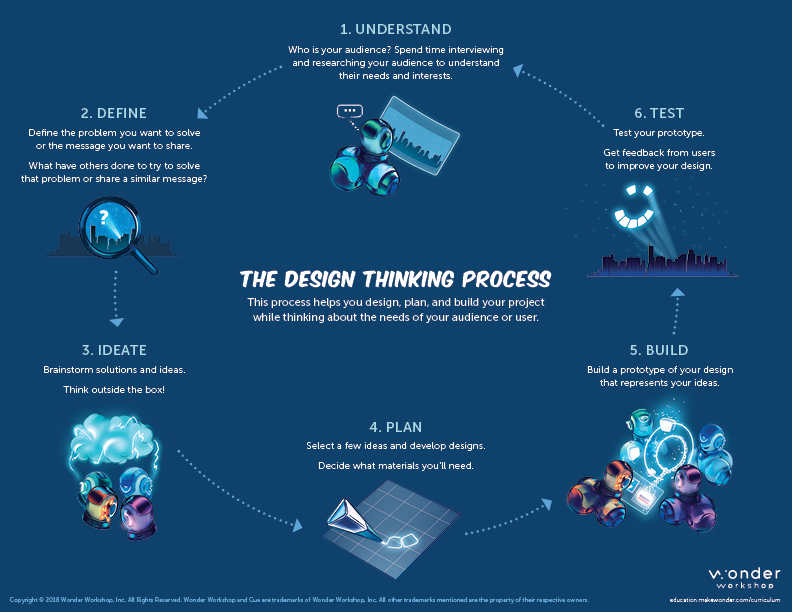
Download this printable to hang in your classroom!
Lesson Plan: Design Thinking with Dash
Grade Levels: Elementary / Middle School
Time Required: 2–3 class periods (can be shortened/extended)
Materials Needed:
- Design Thinking Workbook (student copies)
- Dash robots (1 per group)
- Building materials (classroom craft supplies, tape, cardboard, markers, etc.)
- Devices (laptops, Tablets, or iPads) with Blockly
- Evaluation Rubric
- Optional: Dash Planning and/or General Planning worksheets

Lesson Objectives
- Students will learn and apply the steps of the Design Thinking process.
- Students will collaborate to identify and solve a real classroom problem.
- Students will design, prototype, and test an accessory for Dash that addresses their chosen problem.
- Students will practice creativity, problem-solving, communication, and resilience.
Lesson Procedure
1. Understand (Identify Problems)
- In groups, students brainstorm classroom problems without judgment.
- Grade 2-3: Classroom problem
- Grade 4: School problem
- Grade 5: Any problem
- Write all ideas down.
- Select the top three problems and highlight them.
- As a group, choose one problem to focus on.
2. Define (Frame the Problem)
- Groups explain their chosen problem in detail.
- Discuss why this problem matters and why solving it would help the classroom.
3. Ideate (Generate Solutions)
- Brainstorm possible Dash accessory ideas that could solve the problem.
- No evaluating during brainstorming — just idea generation.
- Select the top three solutions and highlight them.
- Pick one solution to pursue further.
- Record details: how will it work? what will it look like?
4. Plan & Build (Prototype)
- Assign team roles (Documentarian, Builder, Programmer).
- Sketch the accessory design.
- Create a materials list.
- Build a prototype using classroom materials.
5. Test (Iterate & Improve)
- Program Dash to demonstrate the accessory in action.
- Run tests and note mistakes.
- Gather feedback from peers and teacher.
- Revise the design to improve functionality.
- Record results and reflect on what worked and what could be better.
Assessment
Use this Evaluation Rubric
Programming:
Students use coding concepts in Dash to bring their design to life. Proficiency is shown by completing tasks independently, with advanced solutions (efficient code, use of lights, sounds, sensors, loops) indicating exemplary work.Reflection & Documentation:
Students record their design process using journals, sketches, or multimedia tools. Strong performance includes clear, thoughtful reflection using target vocabulary, and thorough documentation of each design phase.Collaboration & Communication:
Students actively participate in group discussions, cooperate with peers, and contribute to presentations. High-level performance includes giving constructive feedback to others, incorporating peer feedback, and clearly communicating design ideas.Creativity:
Students generate multiple solutions, apply the iterative process, and refine their ideas. Outstanding creativity is shown when students go beyond expected requirements, developing imaginative, original, and effective solutions.
Extension Ideas
- Host a “Design Expo” where groups present their prototypes to the class.
- Encourage students to document the process in video or photos.
- Challenge groups to refine their design further or combine ideas.
FOLLOW-UP QUESTIONS/DISCUSSION
- Did your design work as planned? Why or why not?
- How could this design be scaled up for use in the real world?
- Do you think other classes could use your accessory/program?
- What was the hardest part of the design process?
- If you had time to redesign, what would you change?











 English
  German
  Spanish
  French
  Polish
  Dutch
Dutch  Portuguese
  Czech
Czech