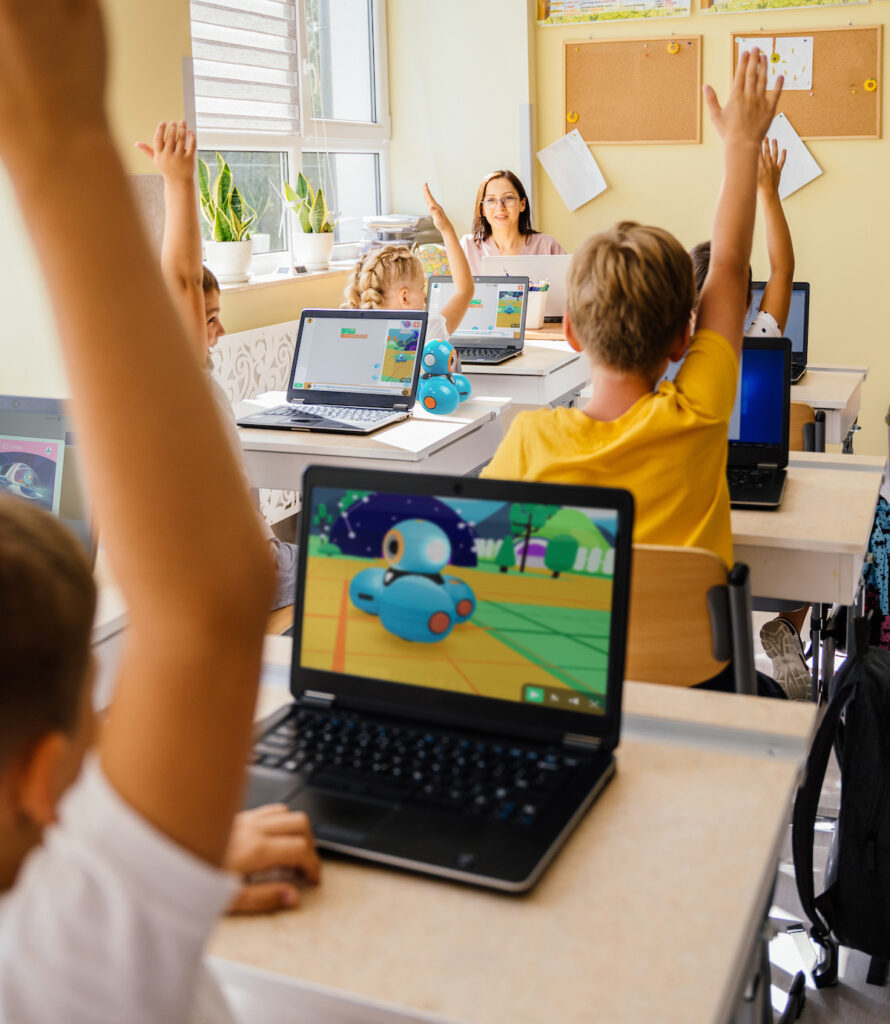

National Robotics Week runs April 4–12, 2026. Here are five activities, drawn from the Make Wonder blog, that you can run with Dash this week, whatever grade you teach and however much time you have.
What is National Robotics Week?
National Robotics Week, known informally as RoboWeek, is an annual, congressionally recognized celebration held each April.
Its origins date to 2009, when leading universities and companies petitioned the Congressional Caucus on Robotics to establish a national roadmap for robotics technology. The following year, the U.S. House of Representatives passed Resolution H.Res. 1055, officially designating a week in April for this purpose.

The mission of RoboWeek is to showcase the robotics industry and its real-world impact while inspiring the future workforce.
The week highlights how robotics drives innovation across fields as varied as manufacturing, healthcare, national defense, agriculture, and transportation.
Equally important is its educational dimension: robotics has proven to be a uniquely effective vehicle for engaging students of all ages in science, technology, engineering, and math — and for inspiring them to pursue careers in those fields. Learn more at nationalroboticsweek.org/about.
For K–8 educators, this week is an opportunity to connect what students are already doing in your classroom to something larger: a national conversation about the role robotics will play in the world your students are preparing to enter. The five activities below are designed to help you do exactly that — using Dash and Blockly as your starting point.
1. The numbers game obstacle course
Grades K–5 · Blockly · 30–45 minutes
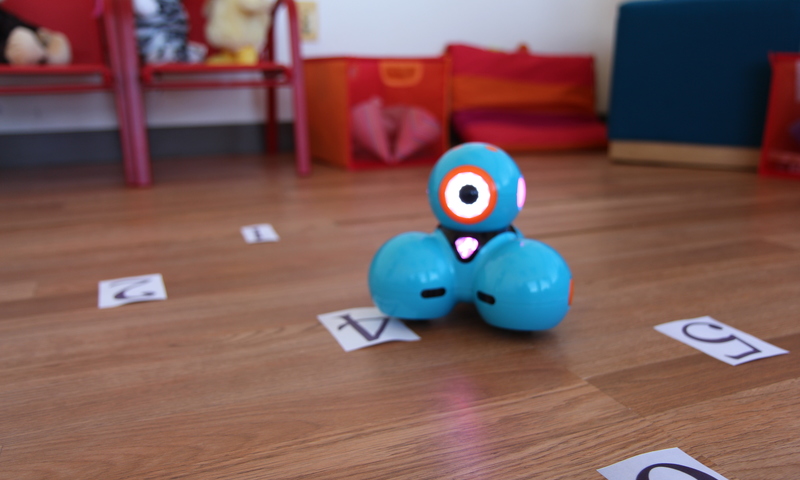
Print or write the numbers 1–10 on cards and tape them to the floor in a random arrangement. The challenge: program Dash in Blockly to visit each number in order. Then backwards. Then odds only. Then evens. The physical setup stays the same — the coding problem changes every round.
What makes this activity effective is the immediate feedback loop. When Dash rolls to the wrong number, students know it instantly and want to fix it. That debugging impulse, the instinct to iterate rather than give up, is the habit of mind you are building. The math integration is a quiet but significant bonus.
Full instructions and discussion questions:
2. Recycling roundup
Grades 2–6 · Blockly · 45–60 minutes
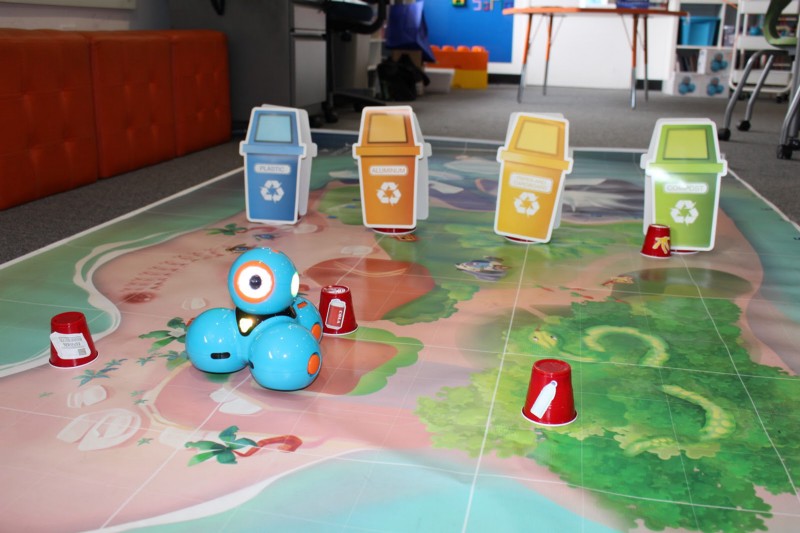
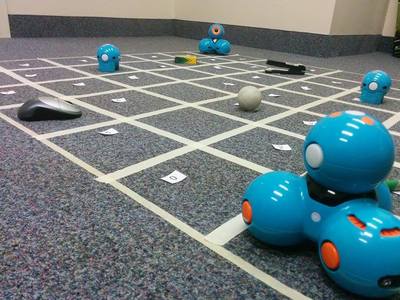
Set up a gridded mat (masking tape works fine) with labeled bins at one end representing different recycling categories. Scatter small objects across the mat as stand-ins for recyclables. Students use Blockly to program Dash to navigate to each item, identify the correct bin, and deliver it.
This activity is naturally cross-curricular. The Earth science context gives the coding a purpose beyond the robot itself, which tends to motivate students who might otherwise see programming as abstract. It also rewards deliberate planning: students quickly discover that the order of operations matters, and that an efficient route requires forethought, a direct introduction to algorithm design.
Full instructions:
3. Place value grid game
Grades 2–5 · Blockly · 45 minutes
Students set up a tape grid on the floor and use Blockly to code Dash to collect and move number cards, working to build the highest possible number using place values. Teams collaborate to plan their moves, write their programs, and revise when the result isn’t what they expected.
This is one of the more satisfying Blockly activities for upper elementary students because the math is substantive, not decorative. Coding on a measured grid also introduces spatial reasoning that carries directly into more advanced programming work. The competitive structure (which team can build the highest number?) keeps energy high without sacrificing rigor. Teachers who have used it report that students often ask to play it again.
Full instructions and lesson plan:
4. Robot petting zoo
Grades K–5 · Blockly · 2–3 sessions
Students select an animal, research its behaviors (how it moves, the sounds it makes, how it reacts to its environment) and then use Blockly to program Dash to replicate those behaviors as accurately as possible. Movement, lights, and audio are all fair game. The result is a classroom of robot animals, each one unique to its programmer.
This activity is well-suited to a RoboWeek showcase. Students present their animal, explain their design choices, and demonstrate their program. The engineering design process is embedded naturally in the task without needing to be named explicitly. Downloadable lesson plans are available through the free tier of Make Wonder.
Lesson plan and printable PDFs:
5. Classroom Wonder League Mini Challenge
Grades 2–8 · Blockly + physical Dash · Full week
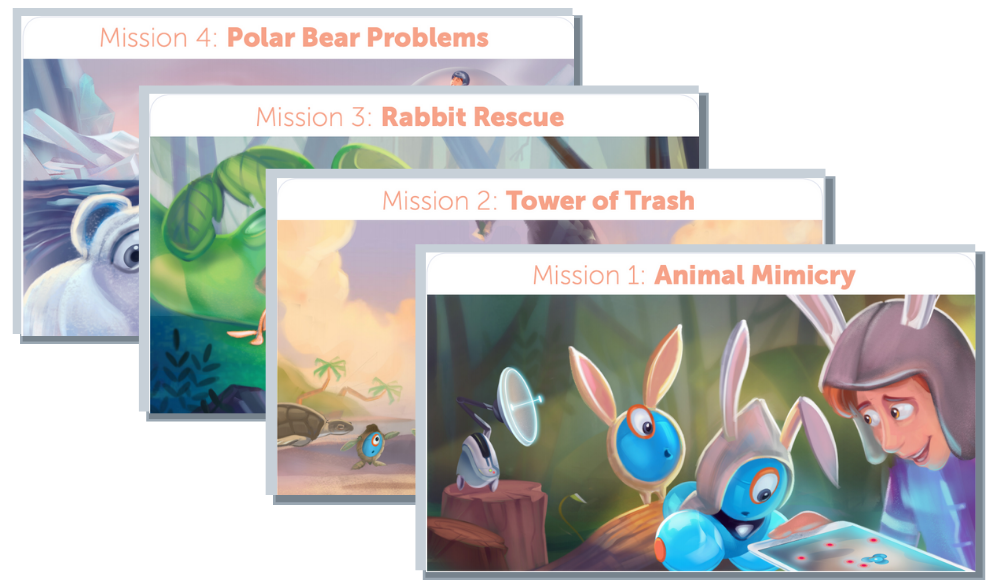
Run your own version of a Mini Wonder League Robotics Competition across the week. Divide students into teams of two to five, assign a mission and give them the week to prototype, test, and refine. On Friday, teams present their solutions and walk through their code.
This format reflects how engineering teams actually work: iterative, collaborative, and time-bounded. For upper elementary and middle school students in particular, the combination of physical building and Blockly programming mirrors a genuine design-and-build workflow. If your students find the experience compelling, the Wonder League Robotics Competition, which will be in its 12th year next year, runs annually from October to May and is designed for students ages 6-12.
Sample Missions Can be Found in our Hour of Code Activity Roundup:
Share what your students create
Post a photo or short video of your students celebrating Robot Week and tag us @WonderWorkshop @moraviaeducation and #RoboWeek. Student work shared during Robotics Week has the potential of inspiring classrooms across the country!
Celebrate each student with this printable certificate:








 English
  German
  Spanish
  French
  Polish
  Dutch
Dutch  Portuguese
  Czech
Czech